Monday, October 8, 2012

Wildlife

In England, much of the wildlife was lost centuries ago, including the top predators. So it was a real treat for me to get to see so many wild animals in the United States, including the biggest badass of them all - the Grizzly Bear.

IMG_3276
Grizzly Bear in Glacier National Park, Montana
Here's a little video of the Grizzly snarfling around. My apologies for the shakiness, the bear was thankfully pretty far away!


Grizzly Bear from Tina Cone on Vimeo.

I never saw any other wild bears except in Glacier National Park, but I did see plenty of other animals across the country.

IMG_4282
Mustangs in North Dakota
IMG_0304
Pronghorn in Yellowstone National Park, Wyoming
IMG_4134
Deer in the Sandhills of Nebraska
IMG_4030
Lady Moose in Grand Teton Park, Wyoming
IMG_2664
Elk on the Oregon shoreline
IMG_3217
Mountain goat snoozing in the snow at Glacier National Park
IMG_3165
Kid and mother in Glacier National Park
IMG_3204
Colombian Ground Squirrel in Montana
IMG_2173
Rabbit in Joshua Tree National Park, California
IMG_4080
Prairie Dogs in South Dakota
IMG_3861
Yellow-bellied Marmot in Yellowstone National Park
IMG_3232
Whistle Pig in Glacier National Park
IMG_4485
Three legged fox in Tahqaumenon Falls State Park, Michigan
IMG_3894
Coyote in Yellowstone National Park
IMG_3580
Lamar Valley Wolf Pack in Yellowstone National Park
I had no idea how rare it was to see and hear a wolf pack in Yellowstone, so I feel very lucky that on my first morning out in Lamar Valley, I was treating to half an hour of wolves howling on top of a hill. I later found out there was a fresh bison carcass nearby so that might have been why they were so excitable. Here's a few minutes of video I shot:


Wolves from Tina Cone on Vimeo.

On the west coast, I was hoping to see some of America's other top predators, Orcas, but sadly they did not show up while I was there. Next time!

IMG_3074
Seals in the Haro Strait, Washington
IMG_3079
Eagles on the San Juan Islands
IMG_3008
Cormorant and chicks in Anacortes, Washington
IMG_1500
Roseate Spoonbill and chicks on Avery Island, Louisiana
IMG_2040
Crow at the Grand Canyon, Arizona
IMG_1866
Mule Deer at the Very Large Array in New Mexico
IMG_1625
Deer in Big Bend, Texas
IMG_1459
Alligator in Lafitte, Lousiana
IMG_4267
Buffalo in South Dakota

The first time I saw a wild bison herd was in Yellowstone National Park. It hearkened back to a time when this whole area had millions of buffalo and literally gave me chills.


Buffalo from Tina Cone on Vimeo.

I also learned that bison, especially when they are in rut in August, are kinda assholes. Every single traffic jam in the Park happened because of this.

IMG_3497
Yellowstone National Park

And once the buffalo were in the road, there was no shifting them. Despite the best efforts of the Park Rangers.


How to move a buffalo from Tina Cone on Vimeo.

Sunday, October 7, 2012

America the Beautiful

I often forget, living in New York, just how incredibly beautiful this country can be. The natural wonders are breathtaking, especially when unencumbered by casinos and other schlock (yes, I'm looking at you Niagara Falls). From the alpine meadows of Montana to the deserts of the Southwest, from the lush forest of the northern west coast, to the sulphuric pools of Yellowstone, from the endless blue of the Pacific to the pine-fresh streams of Michigan. America is Beautiful.


America the Beautiful from Tina Cone on Vimeo.

Saturday, October 6, 2012

This Land is Your Land...

I have just been reading about Isaiah Berlin, a philosopher who pointed out that total liberty for some must necessarily mean constraint for others, that "freedom for the pike is death for the minnows". That holds true for the history of the United States. A country founded under the tenet of "Liberty for All", the expansion and consolidation of the States under its white male oligarchy came at the price of the people who were already living on the land. Treaties guaranteeing Indian safety were broken, entire communities were forcibly relocated and the plains buffalo were systematically exterminated to deprive the Plains Indians of their food source and way of life. It is a period in history that most Americans prefer to forget; and most shamefully, the President who was directly responsible for the Cherokee Trail of Tears is still the face of the $20 bill.

IMG_4149
Wounded Knee graveyard
In 1890, while trying to disarm Lakota Indians on the Pine Ridge reservation in South Dakota, the US Army opened fire, killing men, women and children indiscriminately. The Massacre at Wounded Knee is memorialized with a marker and a graveyard at the site, neither of which were as informative as the people hanging around. A shaking alcoholic and a transsexual covered in burn scars were among those who shared various histories of Wounded Knee while trying to sell tourists cheap jewellery. Unemployment rates on the reservation hover between 80% to 90%, more than half of the residents are living under the federal poverty level, alcoholism and diabetes are rampant and residents have the lowest life expectancy in the country. The minnows may still be alive, but it's barely.

IMG_3792
US graveyard at Little Bighorn with Custer's grave marked in black
The Battle of Little Bighorn in 1876 was one of the few times that the minnows successfully routed the pikes. It is where Lt. Colonel Custer made his last stand, where he and 268 other US troops and Indian scouts were killed after an attack on the Lakota and Cheyenne Indian Village on the banks of the Little Bighorn river spectacularly backfired. Today, the battleground is empty, save for the stones marking where US troops and Indian warriors fell.

IMG_3789
Markers at Little Bighorn battlefield
Nearly 300 years before that battle, Indians in the Southwest were fighting the first colonial power to take their land - Spain. One of the most heinous examples of Spanish cruelty happened in one of the most beautiful areas of New Mexico.

IMG_1971
View from Acoma Pueblo
Many of the Acoma tribe still live in a village perched on a mesa plateau just west of Albuquerque, but back in 1599, the tribe was almost obliterated. Conquistador Juan de OƱate, retaliating for an earlier skirmish, killed hundreds of Acoma men women and children. He also ordered the amputation of every surviving, enslaved adult male's left foot. Somehow, Acoma Pueblo managed to reestablish itself after the massacre and still exists today, though with less than 10% of the tribe's original land.

IMG_1954
Acoma Pueblo

Friday, October 5, 2012

The history of a people is found in its songs

IMG_0670
Sun Studio in Memphis, Tennessee
Visiting Sun Studio in Memphis, Tennessee, was an almost spiritual moment for me. This tiny building nurtured some of the most famous and some of the most talented musicians in the country. Elvis Presley made his first recording here. Johnny Cash was a regular. Blues artists like Howlin' Wolf and BB King recorded here. And the studio even claims to have pressed the very first rock and roll single in 1951. Standing in the room where so much amazing music was laid down for posterity gave me chills in the best possible way.

IMG_0665
Recording room at Sun Studio
The origins of much of the blues and rock and roll sound came from the Mississippi river and its numerous, often seedy juke joints. Only a handful of such places still survive, many of them in the tiny Mississippi town of Clarksdale, where you can stay in an old plantation then drive into town for live music and a few beers late into the night.

IMG_0524
Ground Zero Blues Club in Clarksdale, Missisippi
Further south still, in the Louisiana town of Lafayette, Zydeco and Cajun music abounds. My boyfriend and I stayed in the Blue Moon Saloon and Guesthouse, which has a bar and stage downstairs. Even on a Wednesday, a night open to all musicians who want to join in on the Cajun Jam, the place was packed with people dancing.

IMG_0699
Blue Moon Saloon in Lafayette, Louisiana
One of the more unusual places I stayed was a town called Mountain View in northwest Arkansas. It bills itself as the Folk Music Capital of the World, and you are hard-pressed to find a porch or a corner of the town without someone plucking a guitar or playing a fiddle.

IMG_0471
Jimmy Driftwood Barn in Mountain View, Arkansas
The town is totally dry - no alcohol allowed - so instead the old timers gather in places like Jimmy Driftwood Barn to listen to local musicians. It was a delightful experience, albeit a tad surreal at times, and totally free.

IMG_0715
Sadly they did not perform "Kiss at the End of the Rainbow" from "A Mighty Wind"
As I was winding the trip down and heading back to New York, I had one more must-see musical stop to make. The Motown Historical Museum in Detroit, site of Berry Gordy's apartment and Motown's first recording studio. Marvin Gaye, Stevie Wonder, Smokey Robinson, the Supremes, the Jackson Five and many more all recorded songs here. And while the museum doesn't allow photographs inside the old studio itself, just being allowed to stand there was reward enough.

IMG_4685
Motown Historical Museum in Detroit, Michigan

Thursday, October 4, 2012

One Nation, Under God

America's religious landscape can be disorienting to a European like myself. Since the Enlightenment, the old world has been gradually becoming more and more secular, but over here, in a country that was in many way inspired by the tenets of the Enlightenment, religion is thriving. Most Americans considered themselves "religious",  especially in the South, and despite the clear separation of church and state in the Constitution, religion is often used as a rationale for policies like anti-same-sex marriage amendments. Churches are ubiquitous and often central to a community's identity; in Texas, the state's whole mythology centers on the Alamo where the fighters made their last stand in (what else?) a church.

IMG_0768
The Alamo
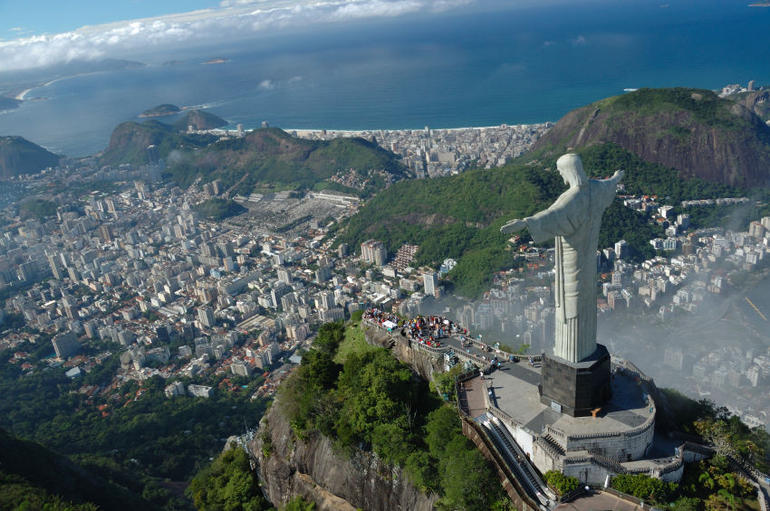
One of my favorite religious displays is just outside the liberal enclave of Eureka Springs, Arkansas. Called The Christ of the Ozarks, it is meant to rival Cristo Redentor in Rio but, hidden in wooded hills, it is a little less visible.

IMG_0803
Christ of the Ozarks, that white blob in the middle
Up close, the differences between this 67 ft Jesus and his 130 ft Brazilian cousin become even more apparent. To quote a seven year old child I happened to overhear as he stared up at the face of Christ of the Ozarks, "Jesus is scary".

IMG_0818
Christ of the Ozarks
Few things get me up early on a Sunday, especially after a Saturday night out in Memphis, Tennessee, but the prospect of a morning at Full Gospel Tabernacle Church with soul singer turned Reverend Al Green did.

IMG_0706
Full Gospel Tabernacle Church
Two and a half hours of stellar gospel music, congregants speaking in tongues, and a rambling service that included Rev. Green railing against baggy pants and advising his teenage son to ask God to help him to stop staring at women's bottoms. Sheer joy - and well worth the early morning start.

IMG_0707
Reverend Al Green
One of the more poignant religious houses in the country is hard to find. Off a dirt track just east of the tiny town of Ross, North Dakota is a tiny, tiny mosque. Smaller even than my first studio in New York, it marks the site of the very first mosque in the United States. Eighty years ago, Lebanese settlers constructed the mosque underground to provide some shelter from the winter weather. Today, the spot is commemorated with a new mosque above ground, which opened just three years ago.

IMG_4348
Little mosque on the prairie in Ross, North Dakota
And from the sublime, to the ridiculous. The Creation Museum in Petersburg, Kentucky opened five years ago and promotes literal interpretations of the Bible. Museum is a loose term, as there is absolutely nothing inside that even vaguely resembles a historical artifact to back up the "facts" presented therein. But there are some wicked smart animatronics that show dinosaurs in the Garden of Eden.

IMG_1147
Adam and Eve in the background, giant dinosaur in the foreground
And why weren't Adam and Eve gobbled up immediately by one of their neighbors you may ask? The Creation Museum has the answer!

IMG_1143
Vegans rejoice
And even after the Fall, dinosaurs were apparently tame enough to be on Noah's Ark and to graze peacefully on rivers right next to young children.

IMG_1123
How it was just thousands of years ago apparently
And the revelations didn't end with the vegetarian dinosaurs. I also learned that the Grand Canyon was caused by the Great Flood, poison dart frogs weren't poisonous until after Adam and Eve got thrown out of the Garden of Eden, and the continents were split by the Great Flood with animals travelling to other parts of the world on rafts of fallen trees.

IMG_1126
You never heard this in school? I wonder why....
I actually feel bad for kids that get dragged here. Not so much for the preponderance of false "facts", but because most of the museum is really boring. The exhibits are mainly just wordy displays that seek to contradict established science. An informed adult could spend hours in there, alternating between anger and amusement but aside from the occasional dinosaur and the petting zoo, there is very little to keep kids entertained.

IMG_1174
Zonkey and Zorse at the Creation Museum petting zoo

Wednesday, October 3, 2012

Rights Turn

The GPS app I downloaded for this trip, MotionX, was absolutely invaluable most of the time. It freed up my eyes to look at the road rather than an enormous map and it navigated my little Ford Focus through city streets or back country dirt roads with pinpoint accuracy. Mostly. Occasionally, as I have noted on this blog, it would send me to the middle of nowhere and proudly declare, as I gazed out on miles of empty asphalt and undulating fields, that I was at Washington and Lee University.

IMG_0912
Birmingham Civil Rights Institute

The GPS made a far more pointed mistake in Birmingham, Alabama. I was trying to visit the renowned Civil Rights Institute, opposite the Sixteenth Street Baptist Church where a Ku Klux Klan bomb killed four young girls nearly fifty years ago. This was my first time in Birmingham, and I was relying on the GPS to guide me to the Institute's address - 520 16th Street North. The GPS took me instead to 16th Street South. As I approached the address, the decay was palpable. Dozens of businesses were boarded up. Carcasses of burnt out houses stood, untouched, in their lots. Empty soda cups and other trash lay in the gutters, almost calcified from lying there so long. I wondered why this part of the city had been left to rot, why even the trash hadn't been cleared, where the city services were. It slowly dawned on me that the GPS had got it wrong, and that there would be no museum int his neighborhood. And when I turned on 16th street, and saw the rundown houses and people milling about, I turned around without even stopping to ask for directions. All I knew is that there was no way that Birmingham, Alabama would put one of its most famous museums, and a foremost attraction in the city, down there. Even though they should have. Because 16th Street South epitomized the work that still needs to be done in this country. It is a poor neighborhood, and every single face I saw was black. This is the ongoing struggle for full emancipation in this country, and it is one that Dr. Martin Luther King recognized all too well when he sought to eradicate poverty for everyone in the United States. Money is a potent segregator, and the disproportionate number of black and Hispanic Americans living in unemployment and poverty is staggering. Even more staggering is the massive wealth disparity between black, white and Hispanic Americans, which appears to be at a record high. According to the Pew Research company, the "median wealth of white households is 20 times that of black households and 18 times that of Hispanic households". It is grotesque that such a wealthy country has citizens living in some of the poorest neighborhoods in the developed world. And while the Institute on 16th Street North was informative and moving, as were many of the other civil rights sites I visited, it was what I found on 16th Street South that served as the most potent reminder that the work begun by abolitionists and continued by the civil rights movement is still a long long way from finished.

IMG_0908
Sixteenth Street Baptist Church in Birmingham, Alabama

IMG_0914
Monument in Birmingham, Alabama

IMG_0894
Civil Rights Memorial in Montgomery, Alabama

IMG_0878
Edmund Pettus Bridge in Selma, Alabama, where police beat protestors trying to march on Montgomery in 1965

IMG_0828
Little Rock Central High, Arkansas, whose first black students had to be escorted by federal troops in 1957

IMG_1012
Money, Mississippi where 14 year old Emmett Till was murdered after allegedly flirting with a white woman in 1955

IMG_0675
Lorraine Motel in Memphis, Tennessee where Dr. Martin Luther King Jr was assassinated

IMG_0678
Balcony where Dr. King was shot at the Lorraine Motel

IMG_1359
MLK memorial in Atlanta, Georgia

IMG_1361
MLK's church in Atlanta, Georgia

Tuesday, October 2, 2012

I've been in 51 states, if you include exhaustion

IMG_1633

Driving around the USA from June through September was simultaneously amazing and totally draining. I have a tendency to over-schedule myself and having a vehicle constantly at my disposal just exacerbated it. Hence I found myself crawling into bed after 16 hour days, too tired to do anything more taxing than reaching for the remote. But while this blog may have suffered, I did manage to see some fantastic things this summer like rainbows over the Grand Canyon, sunsets over Mackinac Island, giant sequoias in California, jive joints in Mississippi, teetotalling fiddlers in Arkansas, creationists in Kentucky, gospel church-goers in Tennessee, grizzly bears in Montana, wolves howling in Wyoming, and bison blocking the road in Yellowstone.

IMG_3693

All of which I hope to condense into a couple of manageable morsels in this space over the next week or two. For right now though, I only have one over-arching observation from my 21,233 miles on the road and it is this: Texans are terrible drivers, Californians are even worse, but the worst drivers I encountered in all 50 states? Michiganders.